

Single Girder vs Double Girder Crane: A Complete Comparison of Pros, Cons & Costs
Planning to purchase a new bridge crane? The most critical step in the selection process is deciding between a single-girder and a double-girder crane. This choice directly impacts your equipment budget, lifting height, duty cycle, long-term maintenance costs, and the potential for future production capacity expansion at your facility.
This guide will help you comprehensively weigh the pros and cons of single-girder versus double-girder cranes, align the equipment with your specific operational requirements, and select the optimal solution.
Moving beyond subjective assumptions, we provide a detailed, rigorous comparative analysis based on objective specifications and real-world application data. We break down the structural differences,performance parameters, total cost of ownership, and key advantages of each type, establishing a clear decision-making framework to help you make a professional, efficient, and sound choice that meets your long-term production needs.
What Is a Single Girder Crane?
A single girder crane uses one main bridge beam spanning the runway. The hoist and trolley hang from the bottom flange — that’s called an “under-running” or “underslung” setup.
Key Characteristics
| Feature | Detail |
| Number of girders | 1 |
| Hoist mounting | Under-running (suspended below the beam) |
| Typical capacity | 0.5–20 tonnes |
| Typical span | 5–30 m (up to 35 m for light duty) |
| Duty class range | A1–A4 (light to moderate) |
| Hook height | Limited by beam depth (hoist hangs below) |
| Building requirements | Lighter runway beams, simpler end trucks |
| Trolley type | Low-headroom trolley with integrated hoist |
Structural Design Details
That single beam has to carry everything — hoist weight, trolley weight, and the lifted load — across the full span with no intermediate support. What that means in practice:
• The beam needs to be deeper (taller cross-section) to fight bending
• You get more deflection under load compared to dual-beam designs
• The hoist hangs below the beam, eating into your headroom
• End trucks can be lighter since the total crane weight is lower
Common Applications
• Machine shops and assembly lines
• Light manufacturing and packaging
• Warehouse material handling
• Maintenance bays and workshops
• Small-scale foundry and fabrication shops
• Automotive component handling
• Food and beverage production facilities
What is a single girder crane used for?
A single girder crane is used for light-to-medium lifting applications (0.5–20 tonnes) in factories, warehouses, and workshops where duty cycles are moderate (A1–A4). It features one bridge beam with the hoist suspended below, offering lower cost and simpler maintenance compared to double girder designs.
What Is a Double Girder Crane?
A double girder crane has two parallel bridge beams. The hoist and trolley ride on top of the girders, running on rails mounted to the beam tops — that’s a “top-running” setup.
Key Characteristics
| Feature | Detail |
| Number of girders | 2 |
| Hoist mounting | Top-running (rides on top of beams) |
| Typical capacity | 5–500 tonnes |
| Typical span | 10–35 m |
| Duty class range | A3–A8 (moderate to severe) |
| Hook height | Superior (hoist sits above beams; more lift within same building height) |
| Building requirements | Heavier runway beams, more heavy-duty end trucks and columns |
| Trolley type | Full-frame trolley with separate hoist and travel motors |
Structural Design Details
Two beams sharing the load changes the math:
• Each beam carries roughly half the total load
• Weight distributes across both rails and both sets of wheels
• The trolley frame spans between the two beams, giving you much better stability
• Hook height gets a boost because the hoist sits on top of the beams
• You can mount walkway platforms between the girders for maintenance access
Common Applications
• Steel mills and metal processing
• Heavy machinery manufacturing
• Power plant maintenance
• Pulp and paper industry
• Mining and mineral processing
• Container handling facilities
• Shipbuilding and heavy fabrication
• Cement and aggregate plants
Head-to-Head Comparison: Single Girder vs Double Girder Crane
Here’s the data you need to make a real decision:
| Parameter | Single Girder | Double Girder | Winner |
| Capacity range | 0.5–20 t | 5–500 t | Double girder |
| Maximum span | 30–35 m | 35 m+ | Double girder |
| Hook height | Lower (hoist hangs below beam) | Higher (hoist rides on top) | Double girder |
| Headroom efficiency | Requires more building height for same hook lift | Better hook height in same building envelope | Double girder |
| Initial cost | 40–60% lower | Higher (more steel, dual rails, heavier end trucks) | Single girder |
| Weight (self-weight) | 30–50% lighter | Heavier structure | Single girder |
| Building structure cost | Lower runway beam loads | Higher building reinforcement may be needed | Single girder |
| Installation time | Shorter (simpler, lighter) | Longer (more components, heavier lifts during install) | Single girder |
| Maintenance complexity | Simpler (fewer components) | More complex (dual rail alignment, more wheels) | Single girder |
| Duty cycle capability | A1–A4 (light/moderate) | A3–A8 (moderate/severe) | Double girder |
| Speed (hoist/trolley/travel) | Lower speeds typical | Higher speeds achievable | Double girder |
| Feature options | Limited (fewer accessories) | Extensive (walkways, dual hooks, magnet, grab, cabin) | Double girder |
| Service life | 10–20 years (light duty) | 20–30+ years (heavy duty) | Double girder |
| Floor space below | Hoist hangs below beam (reduces clearance) | Clear space below girders | Double girder |
| Operator cabin | Difficult to mount | Easily integrated | Double girder |
| Anti-sway control | Limited effectiveness | Excellent (rigid trolley frame) | Double girder |
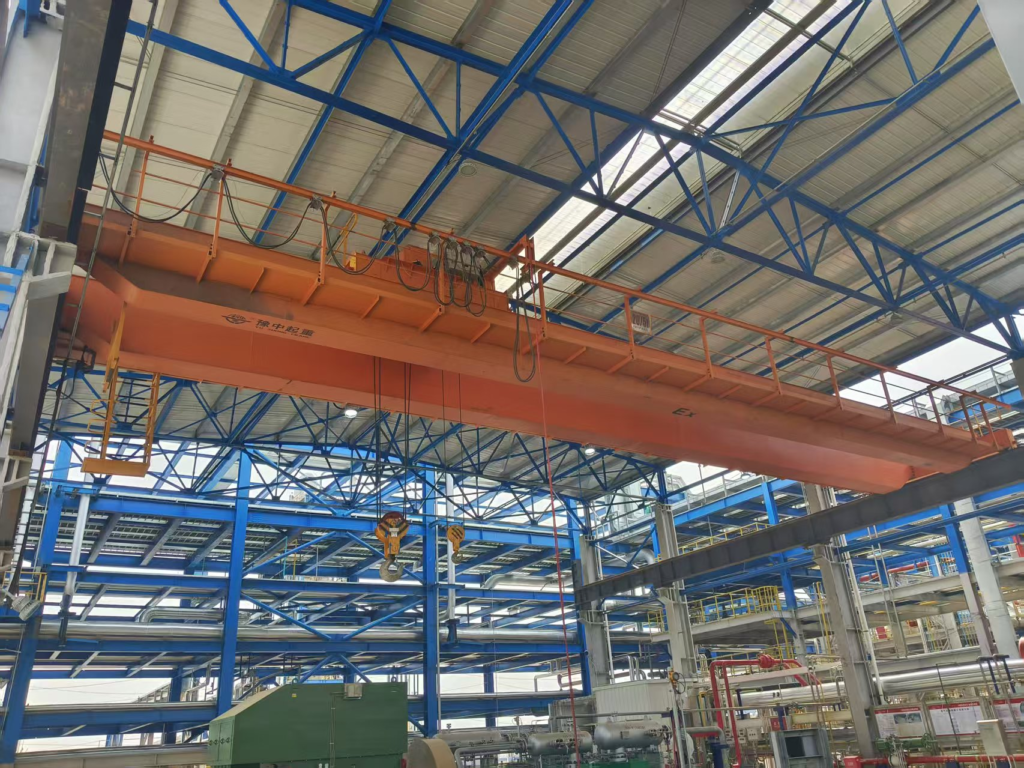
Advantages of Single Girder Cranes
✅ Lower Total Project Cost
This is the big one. A single girder crane costs significantly less than a double girder at the same span — and it also trims your building construction cost because the runway beams can be lighter. On greenfield projects, the combined savings can run into tens of thousands of dollars.
✅ Simpler Maintenance
Fewer parts means fewer things to inspect, adjust, and replace. Wire rope swaps, brake adjustments, rail alignment — all more straightforward. Your maintenance crew can handle the crane without needing specialized training.
✅ Faster Installation
Lighter weight, simpler geometry, shorter timelines. Standard configurations often install in just 1–2 days. Less disruption to the building, and your crane is running sooner.
✅ Adequate for Most General Manufacturing
Here’s the thing: if you’re lifting loads under 20 tonnes, running 1–2 shifts a day, and don’t need extreme hook heights, a single girder crane is technically correct — and economically hard to beat. Over 70% of factory crane installations we see fall within this profile.
✅ Lower Building Requirements
Less crane weight means lower wheel loads on runway beams. Your structural engineer can design lighter beams and columns — saving on steel and concrete. In some cases, that structural saving alone covers the price gap between the two crane types.
✅ Energy Efficiency
A lighter crane draws less power. Smaller motors, less dead weight, lower consumption. Over 15–20 years, that adds up to real money saved on electricity — especially if the crane runs for long stretches each day.
When Single Girder Is the Right Choice
• Capacity ≤ 20 tonnes
• Duty class A1–A4
• Standard hook height requirements
• Budget-constrained projects
• New facilities where building cost matters
• Single-shift or light-duty operations
Advantages of Double Girder Cranes
✅ Maximum Hook Height
Since the trolley rides on top of the girders instead of hanging underneath, you gain roughly one beam depth of extra hook height — usually 500–1,500 mm depending on size. That matters in buildings with tight elevation or where you need max stacking height.
✅ Handles Severe Duty Cycles
Two girders spread the load more evenly, handle higher wheel loads, and take the thermal and mechanical punishment of continuous heavy-duty work. For foundries, steel mills, and multi-shift plants, this isn’t optional. It’s the requirement.
✅ Higher Speeds and Precision
Double girder cranes can pack bigger motors, VFD-controlled drives on all motions, and precision features like micro-speed and anti-sway control. Translation: faster cycles and more accurate load placement.
✅ Greater Feature Flexibility
Walkway platforms, operator cabins, auxiliary hooks, electromagnetic chucks, grab buckets, remote monitoring — all easier to bolt onto a double girder setup. The space between the girders gives you room for cable trays, maintenance walkways, and equipment access.
✅ Longer Service Life
Heavier structural sections, stronger wheels and bearings, built for severe duty — double girder cranes typically run 25–30+ years. That’s significantly longer than single girder installations in comparable environments.
✅ Maintenance Accessibility
The space between the girders and the top-mounted trolley give maintenance crews easier access. Walkway platforms between the girders let your team safely reach electrical components, wire ropes, and trolley drives — less downtime, better safety.
✅ Resale Value
Double girder cranes hold their value better. Longer service life, heavier construction, and a wider range of compatible applications make them easier to resell or relocate if your factory moves.
When Double Girder Is the Right Choice
• Capacity > 20 tonnes
• Duty class A5–A8
• Maximum hook height needed
• Multiple shifts or continuous operation
• Special lifting attachments required
• Expansion plans that may increase loads down the road
• Existing building with headroom constraints
Cost Comparison: Real-World Pricing Factors
The price gap between single girder vs double girder crane options goes beyond the equipment tag. Here’s the full picture:
| Cost Component | Single Girder (10 t / 20 m span) | Double Girder (10 t / 20 m span) |
| Crane equipment | $25,000–$35,000 | $40,000–$65,000 |
| Runway beams | $8,000–$15,000 | $15,000–$25,000 |
| Building columns (if needed) | Standard | May need reinforcement: +$5,000–$10,000 |
| Electrical supply | $2,000–$4,000 | $3,000–$6,000 |
| Installation | $3,000–$5,000 | $6,000–$12,000 |
| Annual maintenance | $1,500–$3,000 | $3,000–$5,000 |
| Expected service life | 15–20 years | 25–30 years |
| Total project cost | $40,000–$60,000 | $72,000–$120,000 |
What this tells you: For loads under 20 tonnes, a single girder crane usually delivers 30–50% lower total project cost with plenty of performance. For loads above 20 tonnes or heavy-duty work, the double girder earns its premium — and often it’s the only option that technically works.
Yuzhong Crane can put together a detailed cost comparison for your specific parameters — crane and building structure both — so you see the real numbers before you commit.
Decision Framework: Which Crane Should You Choose?
Work through this step by step:
Step 1: What is your maximum load (including rigging)?
├─ ≤ 20 tonnes → Single Girder is viable
└─ > 20 tonnes → Double Girder required
Step 2: What is your duty class?
├─ A1–A4 → Single Girder is viable
└─ A5–A8 → Double Girder required
Step 3: Is hook height a constraint?
├─ No, building height is adequate → Single Girder is viable
└─ Yes, limited headroom → Double Girder (better hook height)
Step 4: Do you need special features (cabin, dual hooks, magnet)?
├─ No → Single Girder is viable
└─ Yes → Double Girder preferred
Step 5: Budget priority?
├─ Lowest project cost is key → Single Girder
└─ Long-term performance and scalability matter more → Double Girder
Step 6: Future expansion plans?
├─ No expansion expected → Single Girder is fine
└─ Capacity may increase → Think about Double Girder now to avoid reinstallation
Quick Reference Summary
| If your answer is… | Choose |
| Load ≤ 20 t, light duty, budget-focused | Single Girder |
| Load > 20 t, heavy duty, max hook height | Double Girder |
| Load ≤ 20 t, but need cabin or special attachments | Double Girder (or European-type single girder) |
| New building, optimizing structure cost | Single Girder |
| Existing building with headroom constraints | Double Girder |
| Multi-shift, 24/7 operation planned | Double Girder |
| Future capacity increase likely | Double Girder (future-proofing) |
Real-World Decision Scenarios
Scenario A: Machine Shop
Precision machine shop lifts 3-tonne castings, 2 shifts per day, standard hook height, 15 m span.
→ Single girder crane — 5 t capacity, A4 duty class. Total project cost roughly 40,000.
Scenario B: Steel Service Center
Steel distributor handles 25-tonne coils, 3 shifts per day, needs 8 m hook height for stacking, 22 m span.
→ Double girder crane — 30 t capacity, A6 duty class. Total project cost roughly 120,000.
Scenario C: Warehouse Expansion
Logistics warehouse needs 10-tonne capacity for pallet handling, 1 shift per day, new building under design.
→ Single girder crane — 10 t capacity, A3 duty class. Fine-tune building structure cost.
Scenario D: Automotive Assembly
Automotive plant handles body panels and sub-assemblies (up to 8 tonnes) with precision positioning, clean-room compatible paint system, 2-shift operation.
→ Single girder European-type crane — 10 t capacity, A4 duty class, low-headroom design, epoxy paint. The European-type setup gives you the precision and compact footprint that clean manufacturing environments demand, while staying within single girder economics.
Bottom Line
The single girder vs double girder crane question doesn’t have a one-size-fits-all answer. It depends on your load profile, your duty cycle, your building, and your budget. Single girder cranes own the light-to-medium segment — cheaper, simpler, faster to install. Double girder cranes dominate the heavy-duty, high-capacity world where performance and lifespan are what matter.
Here’s what we tell every buyer: don’t choose on price alone. Match your actual requirements against what each type does best, look at total project cost (building structure included), and think about where your operation is heading. The right crane is the one that delivers safe, reliable service at the lowest total cost over its lifetime.
Henan Yuzhong Crane Group builds both types — and we’ll give you an honest, data-driven recommendation based on what you actually need, not which crane carries a bigger margin.Get in touch for a free consultation and detailed quote.
FAQ
1. What is the main difference between single girder and double girder cranes?
Structural, plain and simple. Single girder has one bridge beam with the hoist hanging below it. Double girder has two parallel beams with the hoist riding on top. That difference drives everything else — capacity (single goes up to 20 t; double up to 500 t), hook height, duty cycle capability, and cost.
2. Is a single girder crane cheaper than a double girder crane?
By a lot. Typically 30–50% less on the equipment itself — and the savings carry through to runway beams, building structure, and installation. That said, for loads above 20 tonnes or heavy-duty applications, double girder is the only option that works.
3. Can a single girder crane handle heavy loads?
Single girder cranes are rated for 0.5–20 tonnes and duty classes A1–A4. They handle general manufacturing, warehousing, and light assembly just fine. Beyond 20 tonnes or duty class A5 and up, you need a double girder for structural integrity and safety. No workaround.
4. Which crane has a longer service life?
Double girder, generally. They’re built for heavier, more demanding work with stronger components — 25–30+ years is normal. Single girder cranes typically give you 15–20 years with proper maintenance. What really determines lifespan is your duty cycle, how well you maintain it, and the operating environment.
5. Can I upgrade from single girder to double girder later?
Usually that means pulling out the old crane and putting in a new one — which might also mean upgrading your runway beams. But if you know capacity needs will grow, planning for double girder from the start (with properly sized runway beams) saves you the reinvestment later. Reach out to Yuzhong Crane if you want advice on future-proofing your setup.