

Gantry Crane vs Overhead Crane: Which One Do You Need?
Choosing between a gantry crane and an overhead crane is one of the most common dilemmas industrial buyers face. While both systems lift and move heavy loads, their structural designs, installation requirements, and ideal applications differ significantly. This guide breaks down every key difference so you can make an informed decision for your facility.
By choosing a reliable manufacturer, you can select from a wide range of fully equipped lifting equipment—such as 5–500 ton MG-type gantry cranes and 0.5–20 ton European-style single-girder overhead cranes—offering comprehensive product lines and extensive options. So, how do you select the right crane for your specific operating conditions?
When to Choose Which
Choose a gantry crane if your facility lacks a reinforced building structure, you need outdoor lifting, or you require a freestanding system that can be relocated. Gantry cranes use legs to support the bridge girder, eliminating the need for runway beams attached to a building.
Choose an overhead crane if your building already has adequate structural support, you need to maximize indoor coverage, and you want to keep floor space clear of support columns. Overhead cranes run on elevated runway beams attached to the building’s columns.
Key takeaway: The decision largely comes down to your building infrastructure and whether you need indoor or outdoor coverage.
What Is a Gantry Crane?
Structure & Working Principle
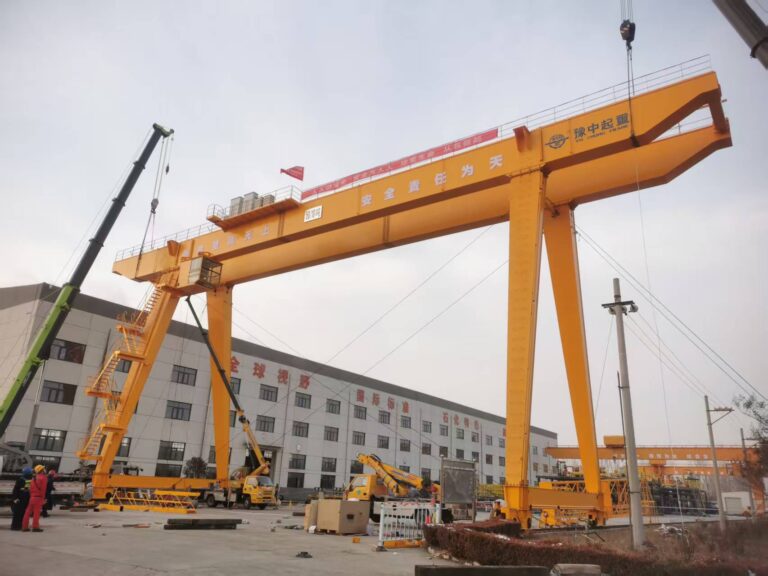
A gantry crane consists of a horizontal bridge girder supported by two or more vertical legs that travel on ground-level rails or wheels. The hoist and trolley move along the bridge, providing three-axis movement: lengthwise (along the bridge), crosswise (via the trolley), and vertical (via the hoist).
Because the legs bear all loads directly to the ground, the crane is entirely self-supporting. This means it does not rely on the building’s structure for load-bearing.
Typical Applications
Gantry cranes are the go-to solution for:
- Outdoor storage yards — loading and unloading materials exposed to weather
- Shipyards — lifting hull sections and heavy components
- Construction sites — temporary or semi-permanent installations
- Steel and scrap yards — handling raw materials and finished products
- Railway depots — maintenance and cargo handling
- Ports and container terminals — container stacking and transfer
Load Range & Specifications
Modern gantry cranes cover a remarkably wide capacity range:
| Parameter | Range |
|---|---|
| Load capacity | 5 – 500 tons |
| Span | 10 – 50 meters |
| Lifting height | 6 – 30 meters |
| Working class | A5 – A7 |
| Operating temperature | -20°C to +45°C |
What Is an Overhead Crane?
Structure & Working Principle
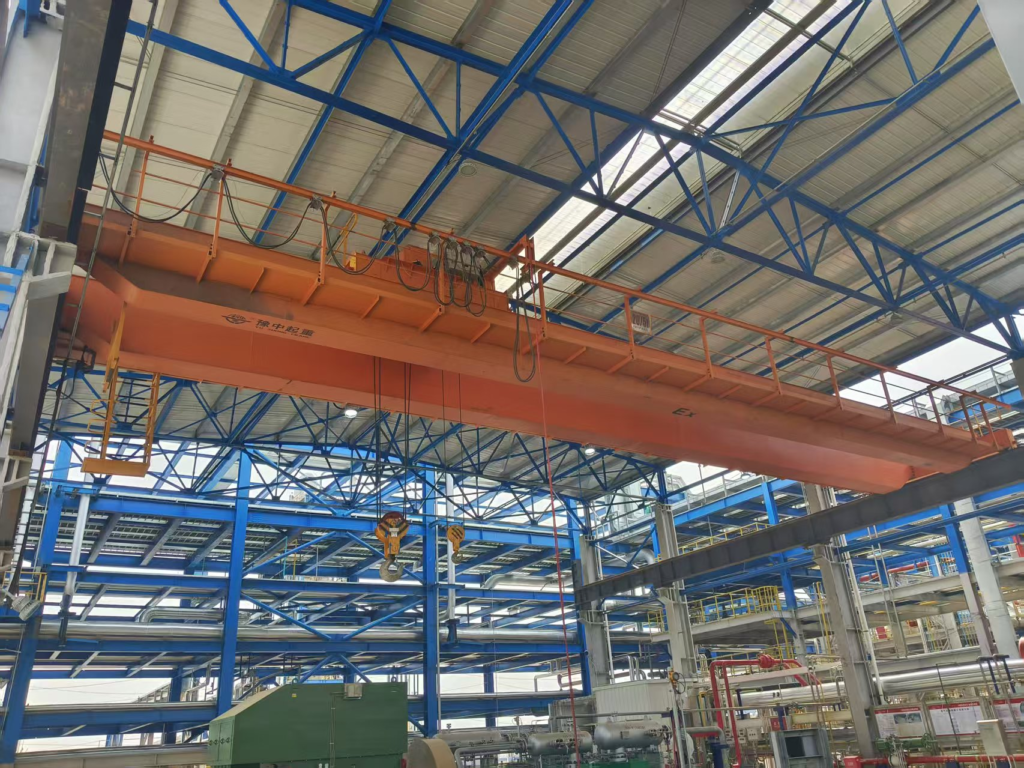
An overhead crane (also called a bridge crane) consists of a bridge beam that spans the width of a building, supported by runway rails mounted on the building’s columns or elevated steel structures. The hoist and trolley travel along the bridge, while the entire bridge assembly moves along the runway — creating a rectangular coverage area.
The key structural difference: overhead cranes transfer loads through the runway beams into the building’s columns and foundation, which must be engineered to support the crane’s weight plus the maximum load.
Typical Applications
Overhead cranes dominate indoor environments where consistent coverage and space efficiency matter:
- Manufacturing plants — production line support, machine loading
- Warehouses — material handling and stacking
- Assembly facilities — component positioning and alignment
- Power plants — turbine and generator maintenance
- Automotive factories — body-in-white and press shop operations
- Foundries — ladle handling, casting operations
Load Range & Specifications
Overhead cranes are available in configurations from light duty to extremely heavy duty:
| Parameter | Single Girder | Double Girder |
|---|---|---|
| Load capacity | 0.5 – 20 tons | 5 – 500+ tons |
| Span | 7.5 – 28.5 meters | 10 – 35+ meters |
| Lifting height | 6 – 30 meters | 6 – 35 meters |
| Working class | A3 – A5 | A5 – A7 |
Key Differences Comparison Table
| Feature | Gantry Crane | Overhead Crane |
|---|---|---|
| Support structure | Freestanding legs on ground | Building columns via runway beams |
| Installation | Simpler; no building modification | Requires structural engineering |
| Indoor/outdoor | Both (ideal for outdoor) | Primarily indoor |
| Cost | Lower building cost; higher steel usage | Higher building cost; less crane steel |
| Floor space | Legs occupy floor area | Fully clear floor |
| Relocatability | Semi-portable (wheeled options available) | Fixed installation |
| Span range | Very wide spans possible | Limited by building width |
| Load capacity | Up to 500+ tons | Up to 500+ tons |
| Maintenance access | Easier (ground-level components) | Requires elevated platforms |
| Wind resistance | Must account for outdoor loads | Protected by building |
How to Choose: 5 Decision Factors
1. Building Structure
Does your building already have the structural capacity to support a crane? If your facility was not originally designed for an overhead crane, retrofitting runway beams and reinforcing columns can add 20-40% to the total installation cost. In this scenario, a gantry crane offers a far more economical alternative.
Conversely, if you’re constructing a new facility and can integrate crane support into the building design, an overhead crane typically delivers better long-term value with full floor-space utilization.
2. Budget
Total cost of ownership involves both the crane itself and the supporting infrastructure:
- Gantry crane total cost = crane price + ground rail foundation (relatively simple)
- Overhead crane total cost = crane price + runway beams + column reinforcement + building modifications
For projects with tight budgets and no existing crane infrastructure, gantry cranes often win on total installed cost.
3. Lifting Requirements
Consider these operational factors:
- Load weight: Both types handle heavy loads, but double-girder configurations in either type are needed above 50 tons.
- Lifting height: Gantry cranes can achieve greater lifting heights without building height constraints.
- Coverage area: Overhead cranes provide seamless rectangular coverage; gantry cranes may have coverage gaps near building walls.
- Speed requirements: Overhead cranes generally offer faster travel speeds due to lighter moving mass.
4. Workspace Layout
If your operation involves moving materials between indoor and outdoor areas, a gantry crane can straddle both environments. For example, an MG gantry crane can pick up materials from an outdoor storage yard and place them inside an adjacent production bay.
Overhead cranes are ideal when the entire operation is contained within a single building envelope and you need to keep the floor completely clear for other equipment and traffic.
5. Future Expansion
Planning to expand or relocate? Gantry cranes — especially wheeled or semi-gantry configurations — can be relocated more easily than overhead cranes, which are permanently integrated into the building structure. This makes gantry cranes a smart choice for temporary installations, phased construction projects, or growing operations that may outgrow their current facility.
Need Help Making the Right Choice?
At Yuzhong Crane, our engineering team has been helping customers select the optimal crane solution since 1978. Whether you need a custom crane design tailored to your specific application or a standard model from our product range, we provide full technical support from selection through installation.
FAQ
What is the difference between a gantry crane and an overhead crane?
The fundamental difference lies in how the bridge girder is supported. A gantry crane uses freestanding legs that travel on ground-level rails, making it self-supporting and suitable for both indoor and outdoor use. An overhead crane runs on elevated runway beams attached to the building’s columns, keeping floor space clear but requiring adequate building structural support.
Can a gantry crane be used indoors?
Yes. While gantry cranes excel in outdoor applications, they are fully functional indoors. The trade-off is that their legs occupy floor space and limit the width of passage underneath the bridge. For facilities where indoor coverage is the primary need and building structure is adequate, an overhead crane is often preferred.
Which crane type is cheaper to install?
In most cases, a gantry crane has a lower total installed cost because it doesn’t require runway beams, column reinforcement, or building modifications. However, the exact cost difference depends on the crane size, building conditions, and site-specific factors. Contact our team for a detailed cost comparison for your project.
Can I convert from an overhead crane to a gantry crane or vice versa?
Yes, but each conversion has significant implications. Converting from overhead to gantry requires removing the runway system and installing ground-level rail or wheel paths. Converting from gantry to overhead requires structural assessment and installation of runway beams. Our engineering team can evaluate the feasibility and cost for your specific situation.
What is the maximum span for each crane type?
Gantry cranes can achieve very wide spans — up to 50 meters or more — since the legs provide direct ground support. Overhead cranes are limited by the building width and the structural capacity of the bridge girder, typically spanning up to 35 meters for double-girder configurations. For spans beyond this, special engineering is required.